Core concepts
The vocabulary used across the Pocketto docs: the pipeline, Pocket Packets, execution logs, lifecycle states, and the Core, Enterprise, and Education layers.
Pocketto is a small system with a precise vocabulary. These are the terms used throughout the documentation.
The pipeline
Six chained skills cover the life of a feature. Each stage produces a file the next stage consumes:
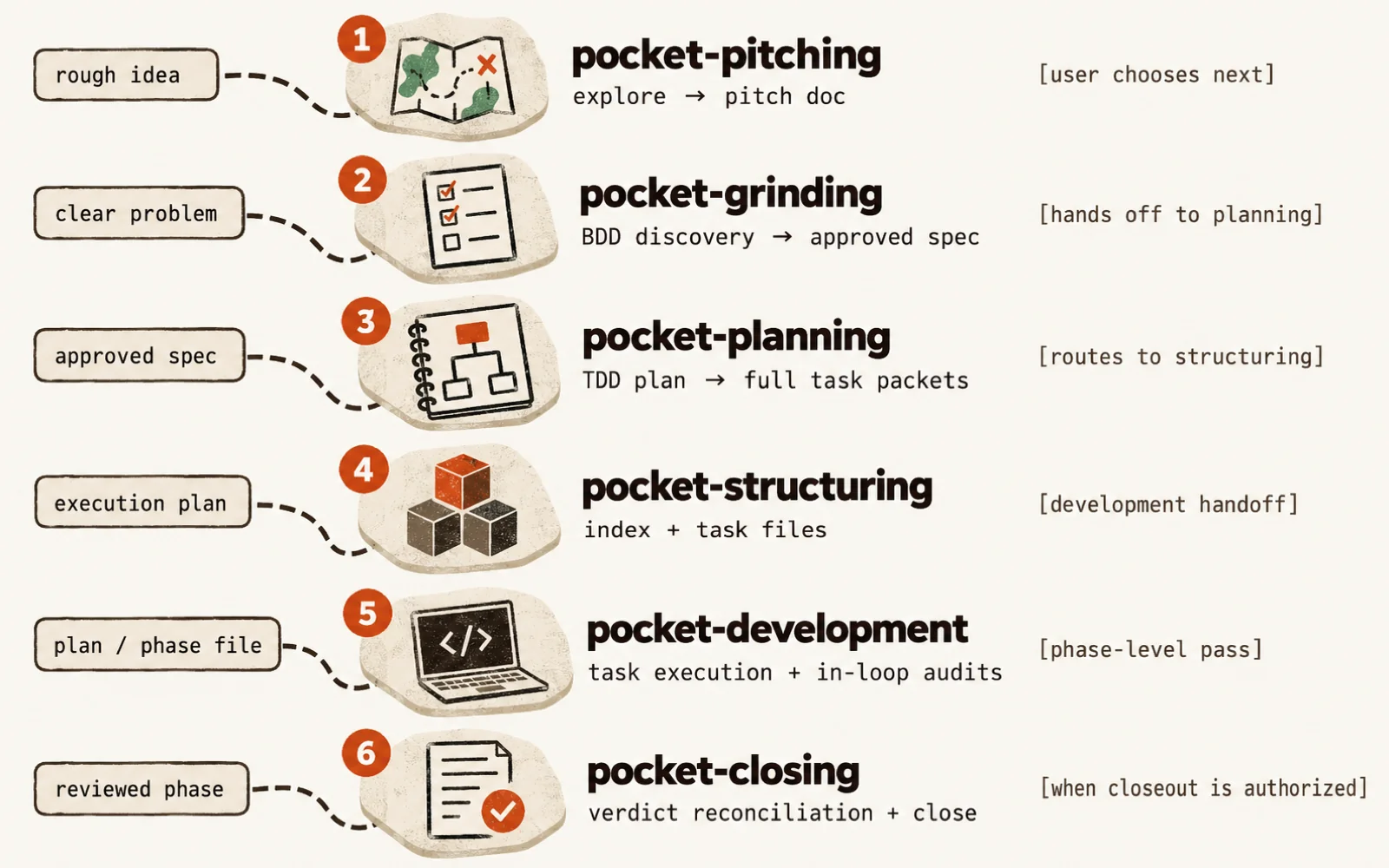
Two properties matter more than the individual stages:
- Handoffs are real. A stage does not "move on" mentally. It saves an artifact to disk and hands its path to the next stage.
- Gates are explicit. Several transitions require your approval, and closing additionally requires you to ask for closeout. See Approval gates.
Standalone skills
Nine single-purpose skills sit outside the chain for everyday work: pocket-help, pocket-init, pocket-education, bug-hunting, hotfix, brand-design, structured-research, and validate-plan. The workflow chooser tells you which one fits.
Pocket Packets
A Pocket Packet is the contract handed to a subagent before it implements anything. It has seven mandatory fields (objective, references loaded, approach justification, sandwich context, deliverable, quality bar, and stop conditions), plus an eighth WORKTREE field for parallel groups. The rule is absolute: no packet, no spawn. See Pocket Packets.
The execution log
Every plan has an execution log, log.json in the plan directory, that records each task and phase with a lifecycle state. The CLI is its only writer; skills run commands, they never edit the file by hand.
| State | Applies to | Meaning |
|---|---|---|
WAITING | tasks, phases | Not started or waiting on a dependency |
DONE | tasks, phases | Completed; for tasks, only after a passing audit with --sha |
REVIEW | phases only | All tasks done and the phase-level pass recorded; awaiting close |
BLOCKED | tasks, phases | Requires a specific human decision, access, information, or authorization |
Tasks go WAITING → DONE | BLOCKED. Phases go WAITING → REVIEW → DONE | BLOCKED. A passing verdict alone never moves a phase. Closing does, on your word.
Lifecycle events
Alongside log.json, Core commits neutral lifecycle events to lifecycle.json: spec-approved, phase-complete, phase-closed (stacked plans only), and plan-closed. Events store artifact references and opaque proof references: never GitHub IDs or credentials. Without Enterprise they stay pending locally; with it, they drive GitHub synchronization.
The three layers
- Core is local-first. It commits state and events locally and never calls
gh. - Enterprise is an optional, additive adapter that consumes those events and owns all remote reconciliation. Missing or incompatible Enterprise never blocks Core work.
- Education is an opt-in mode where the human implements and the agent teaches. It is independent of Enterprise.
Where files live
All durable artifacts live under docs/pocket/: specs in spec/, plans in plans/, research in research/, the brand brief in rule/, learning journals in learning/. The full tree (including log.json, reviews/, and closeout.md) is documented under Generated files.
Getting started
Install Pocketto in Claude Code or Pi, learn the core concepts, and pick a workflow for your first task. No server, no account, and no GitHub required.
Installation
Install Pocketto for Pi or Claude Code from one local-first Core, set up the required Pi extensions, and verify the install with doctor.