Pipeline overview
The six-stage Pocketto pipeline for real features: what each stage receives, what it produces, and where it stops for your approval.
The Pocket pipeline is six chained skills for real features and non-trivial work. Each stage produces an artifact that the next stage consumes, and each stage has explicit gates.
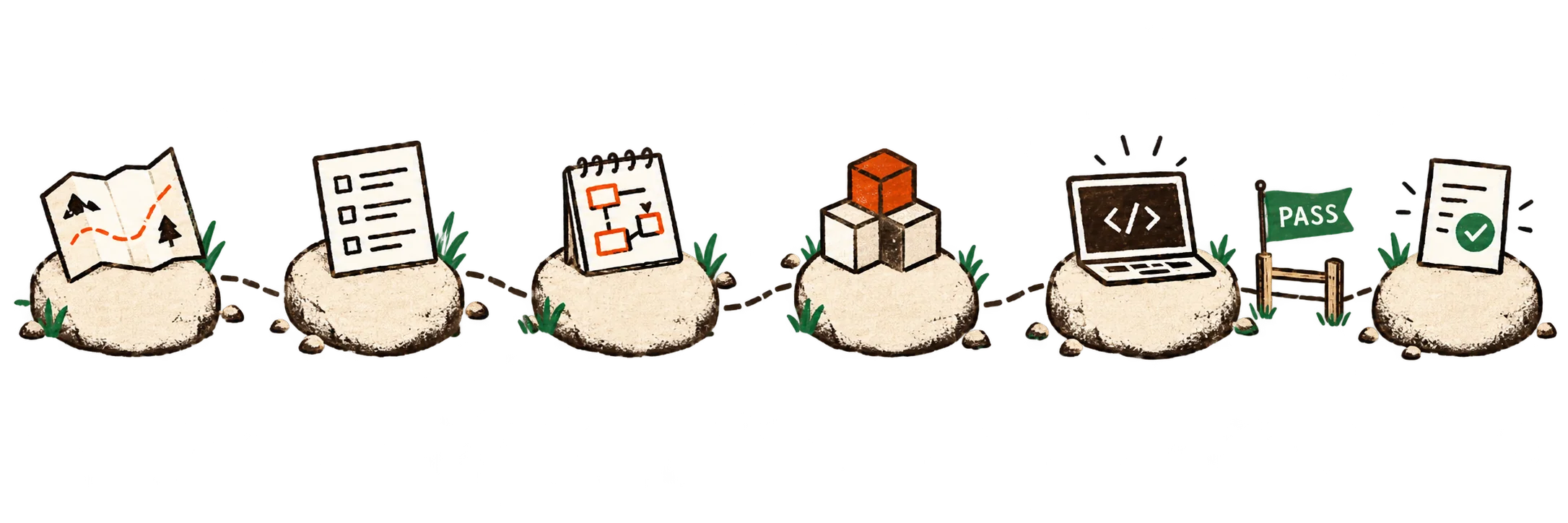
The stages
| # | Skill | Input | Output | Gate |
|---|---|---|---|---|
| 1 | pocket-pitching | A rough idea | docs/pocket/spec/<date>-<slug>/pitch-exploration.md | You choose whether to continue |
| 2 | pocket-grinding | A clear problem | An approved spec with GWT acceptance criteria | Edge-case-hunter review; your spec approval |
| 3 | pocket-planning | The approved spec | An execution plan of full Pocket Packets | Spec-reviewer subagent; CLI dry-run; your plan approval |
| 4 | pocket-structuring | The execution plan | execution-plan/index.md + per-task files | CLI owns decomposition; execution needs your approval |
| 5 | pocket-development | Task files + execution log | Reviewed commits, verdicts, phase-level pass, phase handoff | In-loop audit per task; phase leaves only as REVIEW |
| 6 | pocket-closing | log.json + verdict artifacts | closeout.md entries, advanced phases, a closed plan | You must authorize closeout |
Handoff rules
The chain is not automatic everywhere, and that is deliberate:
pocket-pitchingdoes not auto-chain: after the brief you choose whether to start grinding, iterate, or stop.pocket-grindinghands an approved spec topocket-planningafter your approval, emitting thespec-approvedlifecycle event.pocket-planningroutes every plan topocket-structuringafter plan approval and a mandatory CLI dry-run.pocket-structuringhands off topocket-developmentwhen your instruction already authorizes execution; otherwise it asks once.pocket-developmentleaves a passing phase inREVIEWand namespocket-closingas the next step. It does not close on its own.pocket-closingruns only when you ask for closeout (directly, or via an explicit end-to-end request).
The state model
Tasks move WAITING → DONE | BLOCKED; phases move WAITING → REVIEW → DONE | BLOCKED. A phase only reaches REVIEW after its phase-level pass records a result, and only closing moves it to DONE. See the lifecycle reference.
Lifecycle events
The stages commit neutral lifecycle events locally: spec-approved at the grinding handoff, phase-complete when a phase reaches REVIEW, phase-closed on stacked plans at handoff, and plan-closed at close. See Lifecycle events.
When not to use the pipeline
For everyday work the pipeline is ceremony. Reach for a standalone skill instead: hotfix for small clear changes, bug-hunting for bugs, structured-research for unverified assumptions, brand-design for design systems. Grinding's own triviality off-ramp (details) recommends this switch when the task turns out small.
Related documentation
- Approval gates: every stop point, enumerated
- Execution artifacts: what lands on disk
- Pocket Packets: the delegation contract
Your first end-to-end project
Follow one small feature, JWT refresh-token support, through all six pipeline stages: what you see, what you decide, and what lands on disk.
Pitching
pocket-pitching explores a rough idea before any spec: brainstorming methods, advisor curation, and a pitch doc with a problem statement and 2-3 directions.